If you have been wondering where I’ve been the last three weeks, it is goat kidding season here on the farm which means a chaotic whirlwind of waddling goats finally releasing their long-held hostages in a flurry of grunts, calls, and slimy afterbirth. It often means late nights and early mornings, and sometimes hardly any sleep at all.
I have still been working on researching edible and medicinal herbs and I am really excited to share some things that I’ve discovered! However, I want to do these articles full justice and full-time research has taken a backseat while I’m neck deep in laboring goat and newborn kid chaos! So, to those waiting on the amazing deep dives into foraged food and medicine, sorry for the wait – but it is coming!
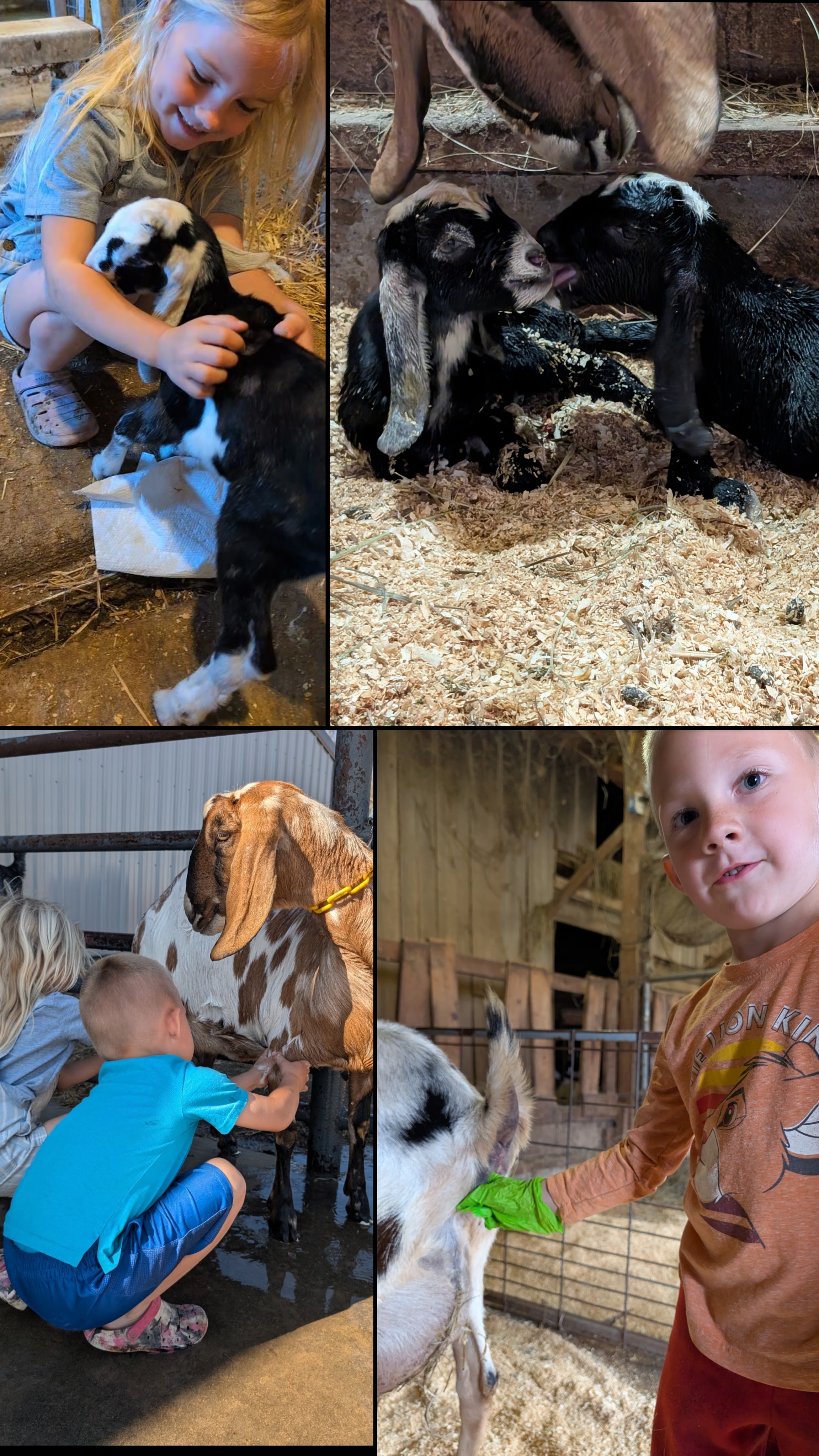
Regardless of the chaos, there is something miraculous about seeing new life enter the world that never diminishes no matter how many times you witness it. And my five year old twins aren’t just witnessing these moments; they are participating in them – even more so this year than ever!
My son was the one who noticed our first doe to go into labor. She was several days early but he saw the telltale slime that means babies are imminent. He ran to get me so we could take her to the kidding pen where she would be more comfortable and our kidding supplies would be easily accessible. For many parents, “the talk” about where babies come from can be a difficult milestone, often cloaked in metaphor. But on a working farm, biological literacy is a foundation we build early.
Our children are present when we breed the cows and the goats so they already possess a rudimentary understanding of how an animal becomes pregnant. When the conversation began about birth, it wasn’t abstract. They were watching close, already deeply engaged and asking questions. We discussed the invisible forces at play—the hormones driving pregnancy, gestation, and lactation. They were allowed to glove up and feel the first kid’s front hooves as they presented ready to be born, but not yet out.
Once the baby was on the ground, we identified the messy but miraculous purpose of the umbilical cord and the placenta as a vital source of nutrition that is no longer needed once the kids are born. We compared the newborn kids’ umbilical stumps to their belly buttons and they learned that they once were supported in the same way in my belly.
This experience, far from being too much for their age, opened a doorway into some of life’s most profound concepts, made entirely real through sight, sound, and touch. Here is why we believe that involving children in these raw, messy events is invaluable.
1. Hands-On Biology and Sensory Education
For a five-year-old, understanding concepts like respiration or anatomy isn’t easy. But the farm offers immediate, sensory definitions.
Minutes before the first kid was born, my children felt the tiny hooves moving inside the doe. They got to witness that exact moment where life shifts from an internal process to an external individual. It is a powerful, tactile way for them to understand the beginning of life.
Furthermore, they weren’t just observers; they were useful. When the kids were born, my children helped clear the airways. They learned, through action, exactly when and why breathing begins, and they felt and saw the first pull of air enter those little lungs. They experienced biology not as a diagram in a book, but as a tactile reality.
2. The Circle of Life
We live in a world that often attempts to separate life from its conclusion, shielding children from the concept of mortality. However, the farm offers a more realistic education. This kidding season provided a profound lesson in that delicate balance: one of our does had originally been carrying triplets, but one had passed away early in the gestation.
While two of the siblings were born full-term and healthy, the presence of the tiny one we lost created a space for an incredibly mature discussion. By being present, the kids could ask questions about the fragility of existence—what happens before that first breath and why some lives continue while others do not.
Witnessing both the grief of a loss and the miracle of a first breath anchored the kids in the reality of farm life. They saw that even when nature is hard, there is still joy and life to be found.
As a parent, it can be tempting to skip the hard parts of nature, but there is a spiritual depth found in the honesty of the farm. We discussed how God is the author of every breath, and how His design includes both the joy of birth and the loss of life on earth.
Even in the loss of the third triplet, we saw divine design. The doe’s body knew how to protect the two healthy babies while letting go of the one that couldn’t stay. It was a lesson for the kids that even in loss, there is a biological—and spiritual—order that we can trust. As my son says often: God knows.
3. Cultivating Stewardship
When we give our kids a real role in the kidding pen, something changes in them. They aren’t just bystanders anymore; they’re caretakers. When they dry a shivering kid or help care for the doe after her labor, they aren’t just ‘helping on the farm’—they are participating in the protection of life. It builds a kind of grit and empathy that you just can’t teach with a book. They’re discovering that life’s most beautiful moments are often the most demanding and the least convenient. By embracing the mess and the unscheduled runs to the barn, they are building a sense of responsibility and a connection to the Creator’s design that will stay with them forever.
If you find yourself in the unique position of involving your own kids in a birth, don’t shy away from the depth of the topic. By embracing these moments, we are not overwhelming them; we are offering them a realistic view of the natural world, anchored in real-life miracles.
While my hands are currently full of newborn kids, milking, and feeding, my notebook is filling up with some incredible research on spring foragables. Stay tuned—once the chaos of kidding season settles, we’re going to dive deep into Purple Dead Nettle, Cleavers, Pineapple Weed (wild chamomile), and Plantain – and how you can bring these healing plants from the field to your home apothecary and table.

 Radiant Roots
Leave a comment and let me know what you think!