“Success requires sacrifice; if it were easy, everyone would achieve it.”
Martin Luther King Jr
The only way you can keep goats is if you love them; and if you love them, you will likely keep them even if you have to sacrifice to keep them. And if you keep dairy goats, there will definitely be sacrifice. To succeed, you need to be willing to lose sleep, comfort, time and money. However, I am getting ahead of myself.
Let’s assume you are a goat lover. And that you are willing to sacrifice for them. What is your next step?
First, I will tell you why you might want to consider my advice. I have a Bachelor of Science in Animal Science from Missouri State University. I have interned with veterinarians and taken Vet Science courses. I have owned goats for decades; first a mixed herd of all different breeds and then my current purebred Nubian herd. I am a Certified Dairy Goat Quality Producer through Langston University and my current active membership with American Dairy Goat Association is going on 15 consecutive years.
I have bred and raised some of the top appraising and top ranking dairy goats in the world with Top Ten Breed Leaders, Elite and Superior Genetics awards. I have exported my breeding stock to other countries and all over the United States as well. I have been selling goat milk and goat milk soaps in addition to Nubian breeding stock for many years.
In a nutshell, I have a lot of experience in what it takes to breed, raise and manage dairy goats. So, how do you get started? I have sorted some information in drop down categories about facilities, supplies and how to find the right goats when you’re ready. Keep in mind this just an introduction so it doesn’t dive into the specifics of diet and nutrition, milking, detailed management, etc. Future posts may go into more details but here is a (hopefully) not overwhelming introduction to dairy goats:
Facilities
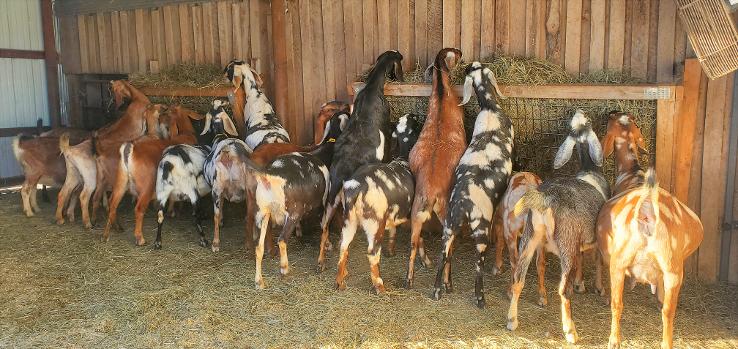
Goats require a three sided shelter that will allow them to stay out of the wind and stay dry. You will need enough space for the number of animals you will want (plan on more than you think because you WILL want to collect them) without fighting for space or stepping on one another. You will need a good system for feeding hay without too much competition. Goats need to have their feed, hay and minerals up off of the ground and where they don’t stand or poop in it. They will also need a clean, fresh source of water. You will want to make sure to have appropriate fencing for the breed you choose. For example, Nigerian Dwarfs require much tighter fencing than Nubians.
Supplies
Items I feel are vital to have on hand at all times:
MOST IMPORTANT: Find and develop a working relationship with a reputable, knowledgeable goat veterinarian – this is harder than it should be but they are out there! Now, on to the items:
Thermometer — getting a temperature is the first step to knowing how to treat a sick or injured animal. A temperature will also likely be the first thing a vet will want to know.
C&D antitoxin — a definite life saver for enterotoxemia cases. This is a MUST HAVE especially if you have kids. Enterotoxemia kills kids fast so I give treatment dose in any situation that a kid stops drinking their milk. *Note: This is NOT the same as the CDT toxoid vaccine…it is an antitoxin that will treat the toxins building up in their gut.
Penicillin — another must have in the case of enterotoxemia. Penicillin will treat the bacteria overgrowth in their gut. Penicillin can also be paired with Excede, a great broad spectrum antibiotic.
Hair dryer or warming box — yes, just a normal hair dryer will work wonders. I used one for decades until I finally got a warming box which is a huge time saver when I am doing kidding season alone. However, a simple hair dryer can save newborn kids from hypothermia and keep them from losing ears, tails, or feet to frostbite in cold weather. *Note: it does not have to be necessarily cold outside for an animal to become hypothermic so, again, getting a body temperature is important.
Quality probiotic supplement — given to anything under stress, illness, off feed, scours, etc. Achieve Pro is great for kids, especially with scours. My mature goats love the taste of Probios and will eat it like a treat.
Quality electrolytes — treatment/prevention of acidosis and dehydration. Entrolyte HE and Diaque are both good electrolytes. I like Diaque best for kids because you can mix one kid-sized bottle at a time rather than having to mix a whole half gallon at a time like with the Entrolyte HE.
Syringes and needles in assorted sizes for injections, oral meds, and enemas. I keep 1 cc, 3 cc, 6 cc, and 12 cc syringes and 18g x ⅝” and 18g x 1” needles. I also keep a few large syringes (30-60 cc) for lactated ringers and kid tubing.
Good coccidiostat — I have used Sulmet and Toltrazuril in the past but I like Pro Bac C the best. I use it as a daily preventative in my kids. The dose I use for Pro Bac C is double the calf dose per lb (i.e. ⅛ oz for 110 lb calf = ⅛ oz for 55 lb goat) so the dose is small and easily mixed into their milk.
Ketone Meter and test strips — invaluable for heavy bred does or just freshened does who are “off” so that pregnancy toxemia or ketosis can be caught early enough to treat and have a good outcome.
Keto gel — we use Keto-Nia-Fresh which is a high energy and vitamin supplement and given when ketones are high (you want ketone levels to be below 1 on your ketone meter). This can be given 2 to 3 times per day with the total daily amount being around 120 cc. I typically give about 60 cc at a time twice a day until ketones are normal.
There are also items that are nice to have on hand but that you can probably get from your vet or OTC if they are needed:
Dewormers from at least two different classes. The three classes available in the United States are Macrolides (ivermectin and moxidectin), Benzimidazoles (fenbendazole and albendazole), and Imidothiazoles (levamisole and morantel tartrate). Make sure the dewormers you have are effective in your area with your goats. I have used Quest, Quest Plus, and Cydectin sheep drench (Moxidectin), Ivomec Plus or Noromectin Plus injectable (Ivermectin), and Valbazen (albendazole). *Note: Fenbendazoles (Safeguard and Panacur) are largely ineffective in many areas of the United States. Parasites are the number one killer of goats but do not deworm indiscriminately. Fecals will help determine when to deworm and with what. The only time I routinely deworm is immediately after a doe kids as the stress of kidding can cause a parasite bloom.
Lactated ringers — can be given subcutaneously in dehydrated or sick animals that are not drinking to prevent dehydration and acidosis. Life saving in many situations.
Kid tubing kit (tube, syringe, lubricating gel) — for tubing colostrum, milk, or electrolytes into weak, dehydrated, or sick kids if necessary. *Note: do not tube colostrum or milk into a kid unless their body temperature is above 100*F.
Surgical-type gloves — we buy these in bulk. Useful for milking, doctoring, assisting with kidding, etc.
Banamine — pain killer and anti-inflammatory.
Fortified Vitamin B Complex — a great supportive therapy for anything that is ‘off’ and good appetite stimulant.
Broad spectrum antibiotic such as Excede or Biomycin — these two antibiotics can treat most of the common issues you might see in goats from uterine infection to respiratory infection, mastitis, joint ill, and most abortion causing organisms as well.
Molasses — dissolved in warm water for does post kidding and can also be rubbed on newborn kid’s gums to provide a boost of energy and interest if they don’t have much of a sucking response.
Tetanus antitoxin — given at disbudding/castration/tattooing or if an unvaccinated goat suffers a deep wound.
CDT Toxoid — given to kids at least twice around 8 and 12 weeks of age and annually thereafter to protect against clostridium perfringens (enterotoxemia) and tetanus.
Finding the Right Goats
So you have your facilities and your supplies. Now you’re ready for goats. Where you get your goats is very important. If you have done just a little bit of research you will be aware that there are several terrible, chronic diseases that run rampant in untested goat populations. CAE (Caprine Arthritis Encephalitis), Johnes (Paratuberculosis) and CL (Caseous Lymphadenitis) are the three biggies that are contagious and incurable. There are other diseases as well which aren’t quite as bad but you definitely want to avoid such as sore mouth (Orf), Brucellosis, Q fever, pink eye, etc.
The best way to ensure you start off your goat venture with healthy goats is to buy from a reputable breeder who has a tested, clean herd. You will also want to look into breed specific genetic issues such as G6S in Nubians and buy only animals free of genetic defects. You will likely pay more initially for goats from a tested clean herd free of genetic defects but it will mean less money in the long run. Instead of money spent on vet bills and potentially heartache from losing a beloved goat, you will be starting with the best chance of the great experience of having happy, healthy goats for years to come.
Another advantage to buying from a reputable breeder besides the health factor is that most reputable breeders will be happy to help their buyers with their new goats. Having an experienced mentor who is invested in your success with your goats is second only to having a relationship with a good goat veterinarian. Reputable breeders want their goats to thrive in their new homes and want you to succeed in whatever your goat goals are. When you buy their genetics, you are buying a piece of their legacy and they want to watch their goats and legacy flourish, even outside of their own herd.
I hope you find this brief introduction helpful in your goat adventures. Please tell me in the comments what breed(s) of goats you have or what breed(s) you would like to have — or feel free to pick my brain about the different breeds and what might be the best fit for you. Bring me your goat questions – I am always willing to talk about goats! Or, let me know what you want me to write about next!
*Note: I go more into more depth and how to build some handy DIY goat supplies such as kid feeding buckets and kid warming boxes here: https://camelotcattlecompany.com/intro-to-goats.php.


 Radiant Roots
Leave a reply to Dairy Cow vs. Dairy Goats: Which is Right for your Homestead? – Radiant Roots Cancel reply