“But ask the animals, and they will teach you, or the birds in the sky, and they will tell you… In his hand is the life of every creature and the breath of all mankind.”
-Job 12:7-10
We have had several days in a row of brutal cold and deep snow. My kids love to play in the snow, of course, but even they need to thaw out occasionally while their snow pants take a spin in the dryer. While we wait for their fingers and toes warm up, we’re always looking for meaningful indoor fun. Making bird seed treats fits that bill and is the perfect ‘stealth’ activity—it’s a learning powerhouse disguised as a sticky, messy craft. While the kids are busy with their “craft”, they’re actually engaging in brain-building lessons they’ll remember long after the snow melts.
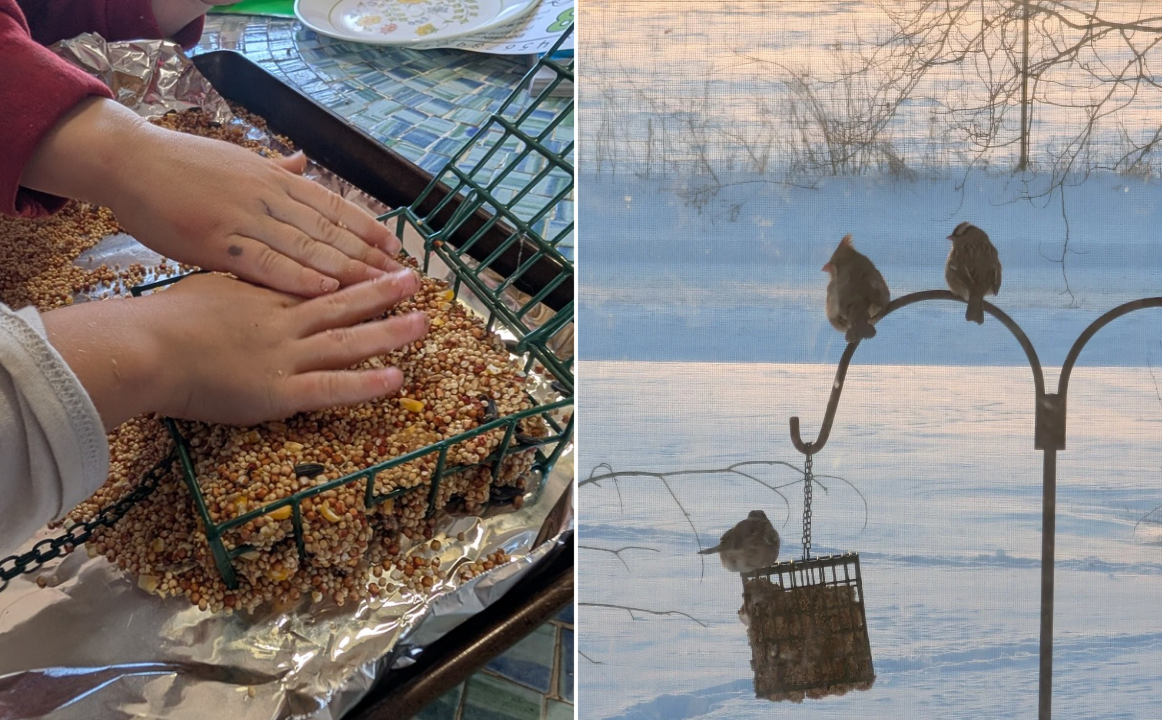
You can make this process as simple or as complex as you’d like. For ours, we kept it easy: I filled a tray with a wild bird seed mix and plopped spoonfuls of peanut butter right into the center. The kids then rolled the peanut butter around until it was completely covered in seeds, forming perfect little energy balls. We tucked ours into a suet feeder, but you could easily go the traditional route: slathering pine cones or sturdy sticks in peanut butter, rolling them in seed, and hanging them from the branches with twine.
*Note: Make sure to cut your twine short, or stick to the suet cage method like we did so no birds get tangled up and injured. Also, please ensure your peanut butter doesn’t contain Xylitol, which can be harmful to animals. Natural peanut butter with no additives is best.
The Brain-Building
No matter how old your kids are, this activity can be tailored to be a great homeschooling opportunity. Here are just some ideas of what you could cover with them:
1. Ecosystems and Survival
Kids learn that winter is a resource-scarce time. Through this activity they can learn about:
- Energy Requirements: Birds need high-fat foods (like peanut butter and seeds) to maintain their body temperature in the cold.
- Animal Adaptation: Not all birds fly south; some have evolved to survive the winter, and we can help bridge the gap when their natural food sources (insects, seeds, and berries) are frozen, covered in snow, or gone.
2. Biology and Observation
Once the treats are hanging, the “field work” begins. Kids can practice:
- Species Identification: Noticing the difference between a cardinal, a chickadee, and a nuthatch. Learning how to distinguish male from female (sexual dimorphism) in many species and learning that some are indistinguishable (monomorphic – looking at you, blue jays!)
- Animal Behavior: Observing “pecking orders” (which birds are bossy and which are more flighty?) and how different species prefer to eat (clinging to the treat vs. picking up scraps on the ground).
3. Sensory Science and Physics
The process of making the treats is a great sensory and tactile lesson in material properties:
- Cohesion and Adhesion: They see how a binder (peanut butter) holds loose solids (seeds) together.
- Gravity and Tension: They learn how to secure the treats so they don’t fall, experimenting with different methods. (Mine enjoyed smashing their carefully formed balls together into a patty in the suet feeder.)
4. Stewardship and Empathy
This activity shifts a child’s perspective from being a passive observer of nature to an active caretaker.
- Responsibility: Checking the feeder regularly to see if it needs a refill.
- Impact: Seeing a direct, positive result of their hard work when a bird actually lands and eats. My kids were absolutely thrilled to see the birds eating their treats and even asked to go out with a light to check for birds after dark (which prompted another educational discussion about diurnal vs nocturnal animals).
More Learning Opportunities
If you want to dive in deeper, you can discuss why different seeds attract different birds, going into details about different needs for different species, beak types compared to feed types, and where the birds might naturally find those types of food on their own.
If you have squirrels in the neighborhood, this can also become a lesson in engineering, as kids try to figure out how to hang the bird treats where the squirrels can’t reach them!
Bring Faith Into It
1. Divine Provision (Matthew 6:26)
This is a great verse to talk about with this activity. It teaches us about trust and faith:
- The Lesson: Jesus specifically points to the birds to show us how much God loves us. If God ensures a tiny sparrow has enough to eat in the dead of winter, how much more will He take care of us?
- The Connection: As the kids hang the treats, explain that they are acting as God’s helpers in His system of provision. Just as God can use people to bless other people, He can use us to bless the rest of His creation.
2. Stewardship of Creation (Genesis 2:15)
In the Bible, humans are tasked with tending the garden.
- The Lesson: We aren’t just consumers of the earth; we are stewards.
- The Connection: Taking care of birds during a harsh winter is a practical way for kids to exercise their God-given responsibility to care for the creatures of the air. It teaches them that even the smallest life is valuable to the Creator.
3. Faith Without Works (James 2:14-17)
Making the bird treats is a physical manifestation of love and care for God’s creation.
- The Lesson: Compassion isn’t just a feeling; it’s an action.
- The Connection: Talk about how we can pray for people, but we should also look for ways to practically “feed” and “warm” those in need. The seed treats are a work that brings life to the bird, just as our kind actions can bring life to others.
4. The Harvest Principle (Galatians 6:9)
You put the seeds out now, but the birds might not come for hours or maybe even days.
- The Lesson: There is always a gap between planting and seeing results.
- The Connection: Hanging the bird treat is an act of faith. We don’t see the birds immediately, but we trust the “harvest” (the birds visiting) will come at the proper time. It teaches kids that doing good is worth it, even when the reward isn’t instant.
Reflection Questions for the Kids
Just some ideas to spark conversation during the activity:
- Design: “Look at how perfectly a bird’s beak is made to crack these seeds. Do you think that happened by accident, or did God design it that way?”
- Wait and See: “We can’t force the birds to come to our feeder; we have to wait patiently. If the birds don’t come to the feeder as soon as we hang it up, does that mean our work was a waste, or does it just mean the ‘harvest’ hasn’t arrived yet? How can we keep a ‘happy heart’ while we wait for God to show us the results of our hard work?”
- Hidden Strength: “A bird is so small, yet it can survive a freezing night. Where does that strength come from?” This could also circle back into God’s perfect designs.
The Conclusion
As they watch the first bird land on their handmade treats, I pray that the seeds of faith, patience, and stewardship take root in the hearts of our children; that they realize that no creature is too small for God’s care—and no act of kindness is too small to be used by Him. So, the next time the snow piles up, grab the peanut butter and some bird seed.
What is your favorite bird to spot in the winter? What are your favorite winter activities? Share with me in the comments!


 Radiant Roots
Leave a reply to A Winter Wonderland of Wildlife Tracks – Radiant Roots Cancel reply