“The tracks we find in the snow are more than just footprints; they are the signatures of the Creator, proving that even in the deepest winter, His world is vibrantly alive and perfectly sustained.”
Winter weather often makes us want to get the necessary outside chores done as quickly as possible in order to cuddle in a warm blanket close to a wood stove. Winter can be a season of warm blankets and good books, but, it can also reveal a fascinating story written across the snowy landscape. This time of year offers a unique opportunity to connect with God’s creation in a profound way – by discovering the hidden stories left by His creatures in the snow.
Beyond the Cozy Hearth: Embracing God’s Outdoor Classroom
We all know the winter chore grind can be wearing, but once the ice is busted and the buckets are filled, don’t head straight back to the house. A sparkling blanket of snow can transform your familiar surroundings into a giant, interactive textbook just waiting for your discovery. Each footprint, every trail, is a testament to the diverse and intricate design of our Creator. It’s an invitation to step outside, breathe in the crisp air, and embark on an adventure.
Why Track Wildlife?
Tracking wildlife in the snow offers so much more than just a fun outdoor activity:
- A Deeper Understanding of God’s Design: Each track tells a story of movement, feeding, and survival. You’ll begin to appreciate the unique adaptations God has given each animal to thrive, even in the harshest conditions. When you look at a track, you aren’t just seeing a footprint; you’re seeing a specialized tool. A bobcat’s retracted claws for silent stalking, the “snowshoe” feet of a rabbit, or the way a deer’s hooves are designed to find purchase on ice—all of these reveal a Creator who is specific and intentional, and who cares about the smallest details of His children’s lives.
- Practicing Observation and Discernment: Tracking requires careful observation and logical deduction. How crisp and fresh are the tracks? How big are they and how deep did they sink into the snow? Are there other signs around such as tracks left from a tail or maybe even wings? What direction was the animal going? Was it running or walking? What was it doing? Where do the tracks lead to and from? These questions sharpen our minds and encourage us to look closer at the world around us.
- Connecting with Our Homestead Environment: For homesteaders, understanding the wildlife that shares our land is crucial. Tracking can help us identify potential visitors (wanted or unwanted!), understand their patterns, and learn how to coexist peacefully with them.
- Fostering a Sense of Wonder and Gratitude: There’s a special awe that comes with knowing you’re following in the footsteps of a wild creature, perhaps one you rarely see. It is amazing the life that you may not even realize is thriving around you; a beautiful reminder of the hidden life all around us, sustained by a loving God.
Getting Started: What You’ll Need
You don’t need much to become a winter wildlife detective!
- Warm Clothing: Layers are key! Hats, gloves, waterproof boots, and warm coats are essential for staying comfortable.
- A Field Guide (Optional but Recommended): A good guide to local animal tracks will help you identify what you find.
- Camera/Sketchbook: To document your discoveries!
- A Spirit of Adventure and Patience: Wildlife tracking is an exercise in both.
Where to Look
- Near Water Sources: Even if frozen, creeks, ponds, and riverbanks are often highways for animals.
- Low Lying Areas: Wild animals prefer to travel in low lying areas where they are less visible from long distances such a valleys between hills or dry creek beds.
- Edges of Fields and Forests: The transition zones between different habitats are often bustling with activity.
- Under Conifer Trees: These offer shelter from snow and wind, making them good spots for animals to rest.
- Around Your Homestead: Don’t underestimate the tracks you might find right in your own yard! You can find tracks such as rabbits, squirrels, and birds even if you live in the middle of town.
Homeschooling Lesson in Action
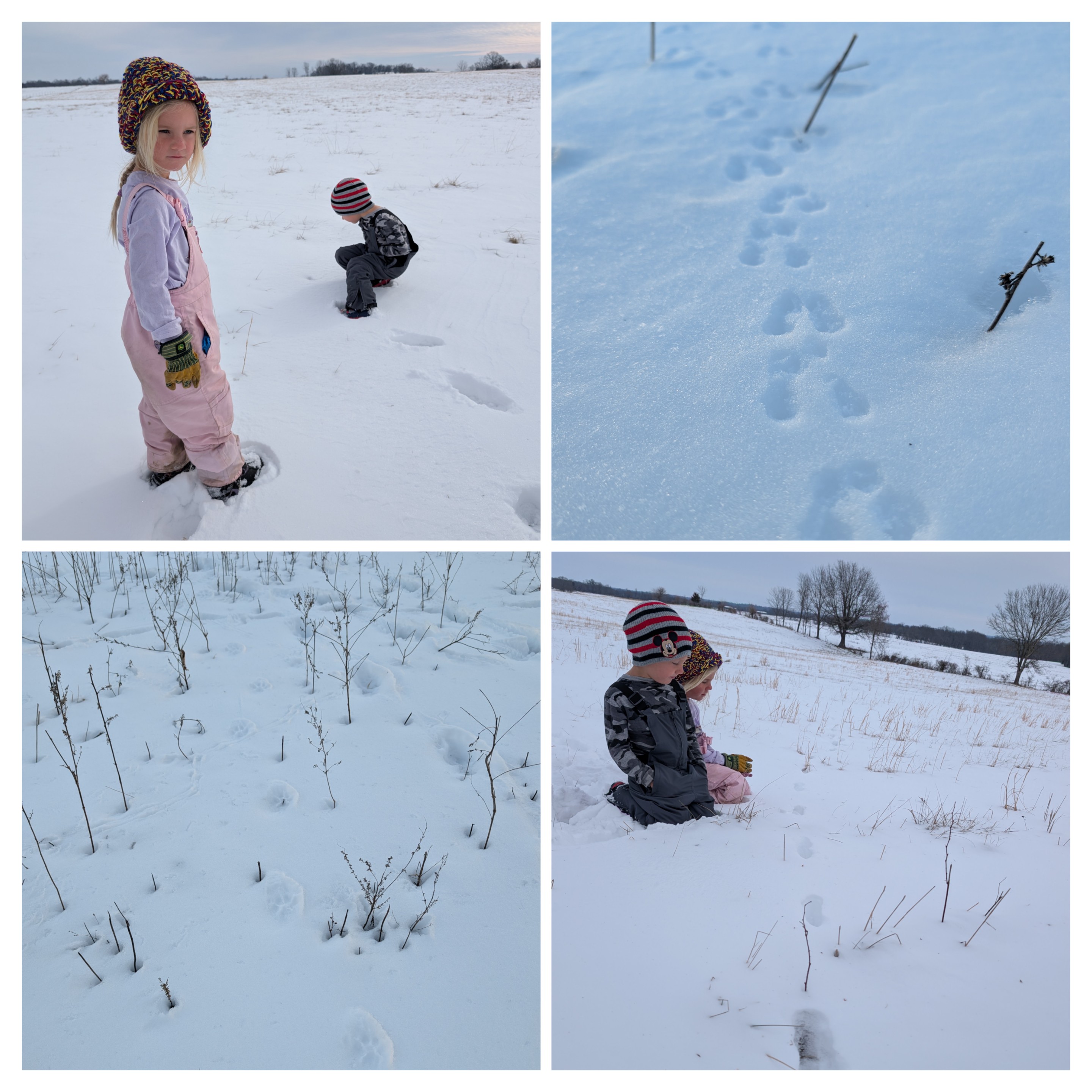
Bundle up the children and head out into the snow. As you find tracks, engage your children with questions:
- “What kind of animal do you think left these tracks?”
- “How many toes do you see?”
- “Can you see claw marks?”
- “Are the tracks in a straight line or meandering around?”
- “What do you think this animal was doing?”
- “How does God provide for this animal in the winter?”
- “What can we learn from this animal’s journey?”
- “Are there signs of digging or foraging?”
Some real life examples from our hike:
The Chase: We followed coyote tracks across a field and found where it had tracked and then hunted a rabbit which used a fence line with its dense brush for cover to escape the predator. We discussed how to identify the coyote and rabbit tracks and which direction they were moving and if they were there at the same time. We hit on the size differences of each animal which helped the rabbit evade the coyote in the tight areas under the brush. It was a perfect lesson in how God provides specific advantages—like size and agility—to help the vulnerable evade the strong. We even found where the coyote squeezed under a barbed wire fence and collected a bit of coyote fur stuck on a barb!
The Light-Footed Foragers: We saw the faint prints from birds and mice proving how small and light they are, causing them to not sink into the snow as they foraged the tiny little grass seeds poking out of the snow. We discussed how the mice can tunnel under the snow, only popping up to forage for seeds before going back under the safety of the snow cover.
Comparisons: Once back in our own yard, we compared the coyote tracks we had seen to our pet dog’s tracks and pointed out the differences in shape and size. We also compared the canine tracks to feline tracks and talked about why they are different (i.e. cats can retract their claws while canines can not).
You might even turn it into a nature journaling exercise, sketching the tracks and noting observations. You could take a deep dive and research the animals you tracked, learning more about their habits and places in the ecosystem.
Bringing it Back to Our Faith
Just as these tracks lead us to discover more about God’s creation, they can also remind us of our own walk of faith. We are called to follow in the footsteps of Christ, leaving a trail for others to see. Our lives, like these tracks, tell a story – a story of faith, perseverance, and reliance on our heavenly Father.
To help your family dive deeper into the spiritual and educational lessons of your winter walk, try discussing points like these while you warm up with a cup of hot chocolate:
- The Signature of the Maker: In Job 12, we’re told the beasts can teach us. After looking at the tracks today, what did you learn about God?
- The Hidden Life: We didn’t see the animals themselves, but we saw evidence that they were here. How is this like our faith in God? Even when we don’t see Him directly, what “tracks” of His presence can we find in our daily lives?
- He is the Great Provider: Tracking often leads you to shelters or foraging sites. Seeing where a rabbit comes and goes from a sheltered burrow, a mouse or bird found an abundance of seeds, or where a squirrel retrieved a buried nut, brings to mind Matthew 6:26: “Look at the birds of the air: they neither sow nor reap nor gather into barns, and yet your heavenly Father feeds them.” If He makes a way for a field mouse in a snowstorm, how much more will He provide for us?
- Stewardship on the Homestead: Looking at the tracks near our garden or barn, how can we be better caretakers of the creatures God has placed on our land this winter? Certainly a fun winter activity such as Sticky Hands, Full Hearts: A Winter Activity for Little Stewards would qualify. Another way I like to provide for the animals is the long-term, low maintenance solution of planting native winter food sources such as sumac, coralberry (buckbrush), persimmons, cedars, and even wildflowers with tall seed heads that stick around through the winter such as Echinacea (purple coneflower), which can provide wildlife food (and shelter in the case of cedar trees) that is accessible even in deep snow.
A Note on Discernment: Part of homesteading is balance. Being a wildlife caretaker doesn’t mean inviting predators to your chicken coop. Good stewardship involves setting boundaries (such as a strong, predator-proof coop) that protect your domestic animals while still honoring the wild ones.
So, this winter, don’t just endure the cold; embrace it as an opportunity. Step outside, seek out the silent stories written in the snow, and marvel at the incredible artistry of our Creator. You might just find that tracking God’s creation in the snow deepens your faith and enriches your homeschooling journey in unexpected ways.
Deep Thought: If someone were “tracking” our family based on the prints we leave behind—our words, our kindness, and our work—where would they say we are headed?


 Radiant Roots
Leave a reply to Michelle DeLong Cancel reply