“Everything has beauty, but not everyone sees it.”
— Confucius
**Before proceeding with this article, please note that these articles in my foraging for food and medicine series are very in depth and therefore can get a bit lengthy. I utilize a type of expanding detail feature for some things (particularly all the recipes) to help organize the post and make navigation easier. This feature does not work when reading directly from your inbox so if you want a more user-friendly read, please check at the top of your email and you should see an option to read directly on my blog where the features all work as they should. Thank you and enjoy!
If Dandelion is the king of the lawn, Pineapple Weed (Matricaria discoidea) is the hardy explorer of the driveway. Often overlooked because it lacks petals, this plant is a powerhouse of scent and flavor that thrives exactly where you’d least expect it.
Origin of Pineapple Weed
Pineapple weed is the ultimate pilgrim plant. While it feels like a permanent fixture of our Missouri farmyards, it actually journeyed here from the Pacific Northwest and Northeast Asia. It didn’t arrive purposefully packed on the Mayflower or in satchels like the dandelion or chickweed; it traveled in the mud.
Because the seeds become slightly sticky when wet, Pineapple weed spent the 19th century hitching rides on the muddy rims of wagon wheels and the boots of westward travelers. By the early 1900s, the plant was spreading at record speeds. It had upgraded its transportation—clinging to the treads of car tires. It followed the development of our modern road system, blooming wherever people traveled.
Identifying & Harvesting
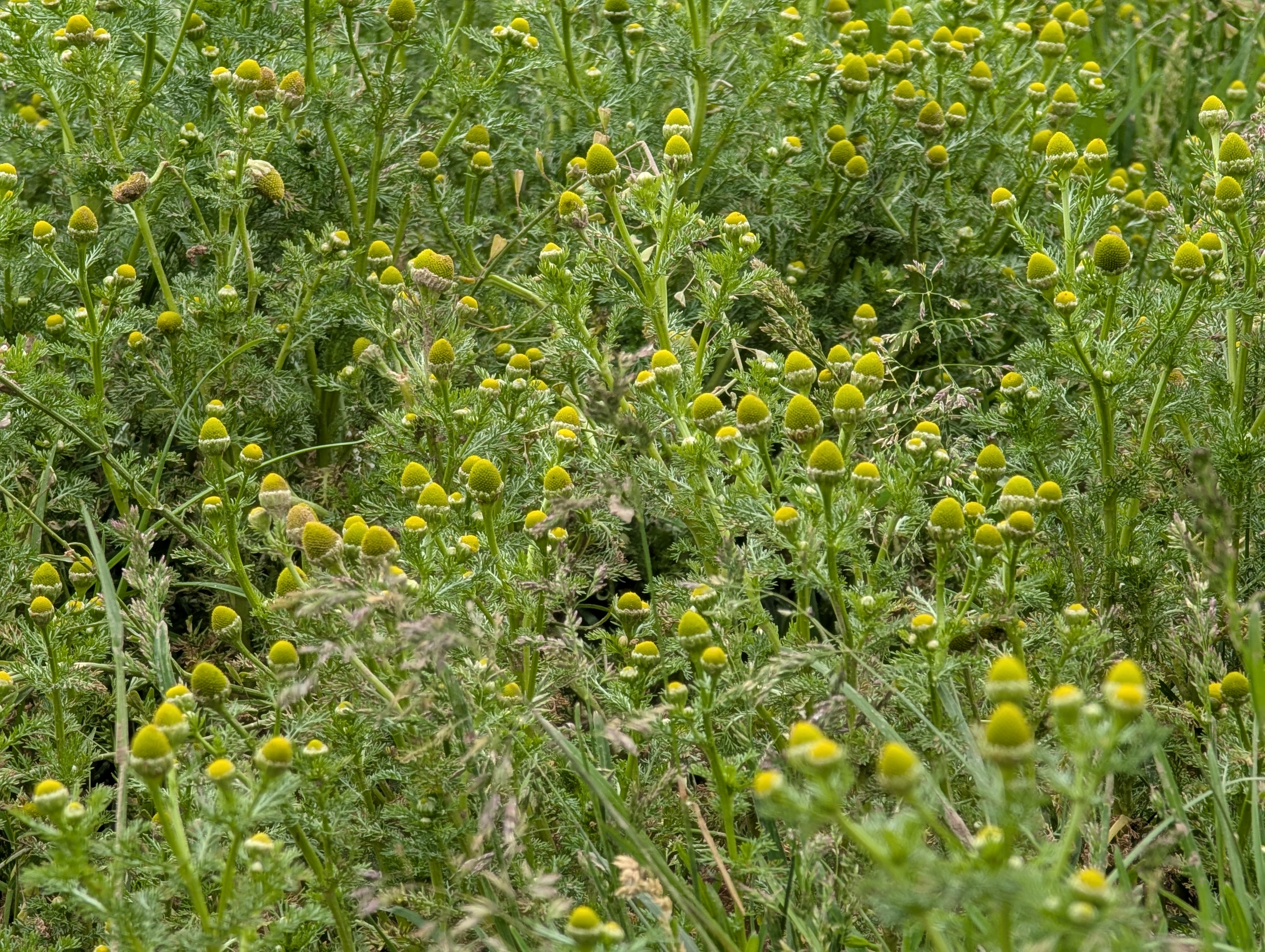
Pineapple weed is a master of camouflage, often blending into the grass until you step on it and release its tropical aroma. It thrives in higher traffic areas where livestock or people walk or even drive. I find it on our farm in heavily traveled livestock areas and along the worn paths where we drive our farming vehicles.
- The Look: It looks like a miniature chamomile plant, but with a twist—the yellow-green flower heads are cone-shaped and completely lack the white petals of true chamomile.
- The Leaves: Feathery, multi-branched, and bright green.
- The Habitat: This plant loves disturbed and compacted soil. Look for it along trail edges, gravel paths, livestock pastures and pens, and even the cracks in your driveway. The seeds like to travel on tires and the soles of peoples’ shoes, so that could give you a good idea of where to start looking.
- The Smell: The best way to identify this plant is by its scent. Rub the bright green flower head between your fingers; you will find that it gives off a lovely fruity fragrance, very much like pineapple.
- Harvesting: Cut or pinch off the cone-shaped flowering heads and leaves, taking care to harvest clean plants as they can be difficult to wash well. Unlike many wild greens, these stay sweet even as the plant matures.
*Pro Tip: Place your harvested pineapple weed in a container and then fill most of the way with cool water. The pineapple weed will float. Swish the pineapple weed around in the water well. Dirt and debris will sink to the bottom and then you can scoop out your clean pineapple weed off the top. I always give it one more cold water rinse in a sieve to finish the cleaning process.
Pineapple weed can be quite prolific, reproducing with thousands of seeds per flower head. Harvesting what you need will likely make no dent in its population but as always, try not to wipe out an entire area when harvesting and only harvest from unpolluted areas that you have permission to harvest from.
Culinary Uses: A Tropical Treat
Pineapple weed flowers and leaves are edible raw or cooked. When crushed, the flowers have the aroma of pineapple and chamomile while the leaves are less fruity and more similar to true chamomile. Pineapple weed is perhaps the best beginner wild edible because it actually tastes like its name. It can be used in salads, vinegars, dressings, syrups, teas, cordials, mead, roasted with carrots, used to flavor cooking meat (especially light fishes), fresh cheeses, and even tossed on a ham pizza!
Safety Note: As with all plants in the Asteraceae family (like ragweed, sunflowers, or daisies), some individuals may have an allergic reaction. Always try a tiny amount first!
I have included links for a few books from which the below recipes come. I may receive a small commission if you make a purchase through them, at no extra cost to you. I will never recommend something unless I have first hand knowledge of it and genuinely believe it to be valuable.
Pineapple Weed Culinary Recipes
Pineapple Weed Tea
Steep a handful of fresh flower heads in hot water for 5–10 minutes. It tastes like a blend of chamomile and pineapple juice. Use fresh sprigs for the best flavor. They still make a tasty tea once dried, but it will be less fruity. Freezing helps keep more of the fruity flavor.
*Note: You can also make a cold infusion by placing pineapple weed in a clean jar and adding water (and sugar or honey, if desired) and then place in the refrigerator for 12-24 hours. Then, strain the contents and store in the fridge. Drink within 3-4 days.
Pineapple Weed Vinegar (and more)
This simple recipe just requires you to half fill a jar with the flower tops, top it up with vinegar, and then leave it for a couple of weeks. Its a great base for salad dressings or pickling other foods.
*Note: If you sweeten your pineapple weed vinegar with sugar to make a shrub (or with honey to make an oxymel) it becomes a magical ingredient for tempering cocktails or diluting with cold water to make a refreshing drink in summer, or with hot water on cold days.
Pineapple Weed Syrup
Pineapple weed readily infuses into syrups which opens the door to jelly and all manner of other sweet treats such as turkish delight.
To make pineapple weed syrup, just mix a bunch of flowers with the same volume of water and the same volume of sugar, heat gently (but don’t boil), stirring until all the sugar has dissolved, allow to cool, then heat gently again, before pouring into jars with the flowers still in. Leave to cool then keep in the fridge for a week, before straining out the flowers. Store in the fridge or freezer, as it will want to ferment. (You can, if you prefer, deliberately ferment pineapple weed to make wine or champagne.)
With the addition of some citric acid (to taste, as powder or as lemon juice), pineapple weed syrup becomes an excellent cordial.
Pineapple Weed Cordial and Ice Lollies
*This recipe is from Foraging with Kids
Ingredients
7 cups water
7.5 cups sugar
zest and juice of 1 lemon
20 pineapple weed Flowers, including leaves, washed and patted dry
Instructions
Put all the ingredients, except for the pineapple weed flowers, into a large saucepan and boil until the liquid has reduced by about half. Remove from the heat and, while the liquid is still hot, add the flowers and leave to cool completely.
Once cool, strain to remove the flowers. Store the cordial in sterilized water bottles. This will keep indefinitely in a refrigerator. You can also freeze it – so be sure to leave 1-1.5 inches of head space in the bottles to allow for expansion if frozen.
To make the lollies, simply pour the pineapple weed cordial into lolly molds, adding lollipop sticks if necessary, and freeze.
Pineapple Weed Custard (Dairy-free/AGS-friendly variation included)
Ingredients
- 1 cup whole milk
- 1 cup cleaned pineapple weed flowers and leaves
- 1 extra large egg
- 2 Tablespoons sugar
- a pinch of salt
Instructions
Preheat your oven to 325F. Combine the milk and pineapple weed in a saucepan and gradually bring the milk to a simmer, whisking to prevent scorching. Allow the milk to barely simmer for five minutes (whisking all the time), then remove the pan from the heat, cover, and let the pineapple weed steep for 30 minutes.
Strain off the solids, pressing down on them to release every possible drop of liquid. Throw away the pineapple weed, then pour the infused milk through a fine strainer (like a yogurt strainer or gold coffee filter) to remove any solids that may have snuck through the first strainer.
Whisk the egg, then combine it with the infused milk, sugar, and salt. Pour your custard into individual dishes, then place those dishes in a large baking pan and fill the pan with hot water until it reaches halfway up the custard dishes. This will help to keep your texture delicate.
Bake your custards for 30 – 50 minutes, depending on the size of your dishes. The custards should be jiggly, but a knife inserted in the center should come out clean.
Remove the dishes from the hot water bath, and let them cool on the counter for about an hour. Then cover the dishes and refrigerate until you’re ready to serve. Top your custard with a few tablespoons of pineapple weed simple syrup, for an extra blast of unbuyable, foraged flavor.
Dairy-free Variation for Pineapple Weed Custard
Ingredients
- 1/2 cup cashew milk (blend 1 heaping Tbsp cashew butter with 1/2 cup water for a simple homemade version)
- 1/2 cup canned full-fat coconut milk (shake the can well before measuring)
- 1 cup cleaned Pineapple weed (flowers and young leaves, packed)
- 1 extra large egg (room temperature)
- 1.5 Tablespoons honey (less if using a sweetened nut milk)
- A pinch of salt
Instructions
Infuse the milk: In a small saucepan, combine your cashew milk, coconut milk, and the pineapple weed. Bring to a very gentle simmer over low heat. Whisk constantly for 5 minutes to prevent any nut solids from scorching.
Steep for flavor: Remove from heat, cover, and let the herbs steep for 30 minutes. This is where the flavor really develops.
Strain thoroughly: Strain the mixture through a fine-mesh sieve, pressing firmly on the solids to extract every drop of infused liquid. For an even smoother custard, you can pass it a second time through a coffee filter to catch any stray sediment.
Combine: Stir your honey into the warm milk mixture until it is fully dissolved. In a separate bowl, lightly beat the egg with the salt. Slowly pour in your infused milk. Stir gently with a spoon rather than whisking vigorously to avoid creating any foam or air bubbles.
The Final Smooth-Off: Pour the mixture into ramekins (or individual dishes, then place those dishes in a large baking pan and fill the pan with hot water until it reaches halfway up the dishes). If you see bubbles on the surface, let it sit for two minutes, then gently skim them off with the edge of a paper towel or the back of a spoon.
Bake: Place ramekins in a preheated oven at 325°F. Bake for 30–35 minutes, or until the edges are set but the center still has a slight, jello-like jiggle.
*Note: Because plant milks behave differently than dairy, your custard may look a little soft when it first comes out. Don’t worry! Let it cool to room temperature on the counter, then move it to the fridge for at least two hours. It will firm up into a perfect, creamy consistency.
Pineapple Weed Frozen Custard (Dairy-free/AGS-friendly!)
*This is a recipe of my own invention and I can’t stress enough how rich and creamy the end result is! Even people who are not at all into foraged foods love this frozen custard. Also kid-approved, even by my pickier eater!
Ingredients
1 (packed) cup of fresh pineapple weed flowers and tender tops
1 can of full-fat coconut milk (I use this Organic Coconut Milk)
2 large egg yolks, room temp (I use our farm fresh eggs)
3-4 TB honey (adjust to your preferred sweetness – I use 4 TB)
Pinch of sea salt
Instructions
In a small saucepan, add your pineapple weed and bruise the flowers to release their oils. I use a wooden spurtle to just gently mash them into the bottom of the pan. Add your coconut milk and bring the mixture to a very gentle simmer and simmer for 5 minutes, stirring constantly. Remove from heat, cover, and let steep for 30 minutes.
Strain through a fine-mesh sieve, pressing firmly (again, I use my wooden spurtle for this) to extract every drop of liquid.
In a separate bowl, whisk the egg yolks, honey, and salt. Slowly pour about 1/4 cup of the warm infused milk into the egg mixture, whisking constantly (this prevents the eggs from scrambling).
Pour the egg/milk mixture back into the saucepan with the rest of the milk. Heat over low-medium heat, stirring constantly with a wooden spoon or spurtle, until the mixture thickens enough to coat the back of the utensil (do not let it boil!). Chill the mixture in the refrigerator for at least 6 hours (overnight is best). This is critical for the texture of the custard.
Pour the cold custard into your ice cream maker and churn according to the manufacturer’s directions. Enjoy the tropical deliciousness by itself or try one of these ideas for a little extra pizzazz:
- Drizzle a bit of pineapple weed syrup over the top.
- Lightly toast some plantain seeds in a dry pan until they smell nutty. Sprinkle them over the custard like sprinkles to add a sophisticated, savory crunch that balances the sweetness, much like salt on caramel.
- Top with a wild berry compote with whatever berries you have available.
- Enjoy with the Dandelion Root Brownies from Dandelions: Not a Weed – A Forager’s and Homesteader’s Treasure!
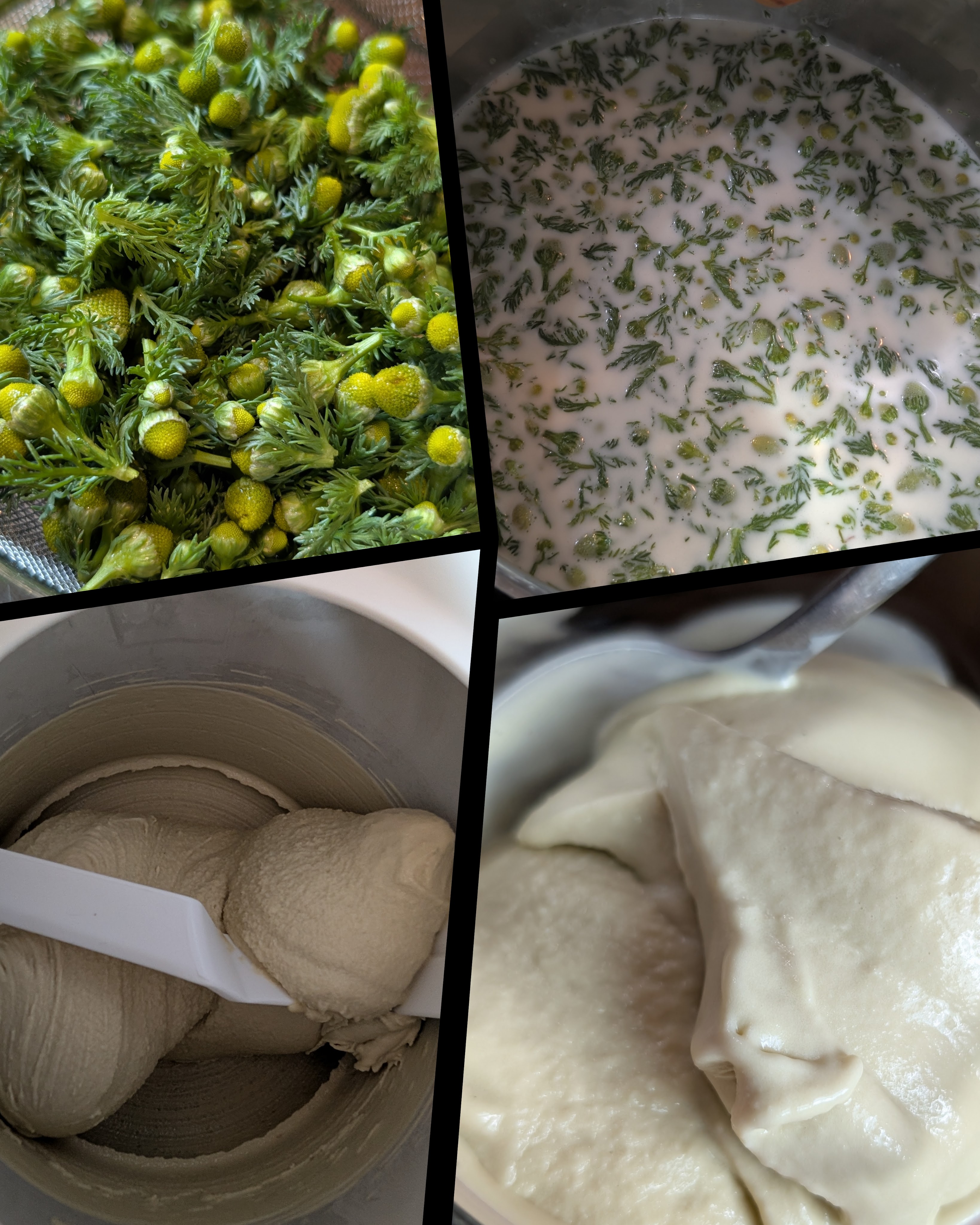
To round off the culinary section, here are a few more simple ideas for using pineapple weed in the kitchen:
- Infused Sugar: Pulse dried flowers with organic cane sugar in a blender. Use it to sprinkle on sugar cookies, bake with, or even rim drink glasses with it.
- Fruit Salad Garnish: Toss the whole raw flower heads into a bowl of strawberries or melon. They provide a surprising pop of flavor and a nice crunch.
- Pineapple Weed Marmalade: Follow a standard marmalade recipe: collect enough flower heads, to match pound for pound with sugar, add all flower heads with sugar and water. Add lemon chopped up small, rind and all. Bring to the boil. Just before it reaches setting point, add in wild oregano and seal in sterile jars.
- Jams and Puddings: Pineapple weed pairs well with wild strawberries – try mixing the two in jams and puddings.
Preserving Pineapple Weed
Pineapple weed is a somewhat delicate plant so using heat to process it in any way is not ideal. Forage it in the morning if you can, rinse if necessary, and pat or gently shake dry.
Drying: Hang the clean pineapple weed in a paper bag in a well-ventilated area. Punch holes in the paper bag to facilitate evaporation. Once the leaves are dry and brittle, place them in a tightly closed jar or other container and store out of light.
Freezing: This is actually the best way to lock in the volatile oils that give pineapple weed its signature pineapple flavor and aroma. There are a few ways to preserve it in the freezer:
1. The Ice Cube Method (Best for Tea & Drinks)
- How to do it: Place 3–5 cleaned flower heads into each slot of an ice cube tray. Fill with water and freeze.
- The Benefit: When you want a cup of tea in the winter, just drop two cubes into boiling water. The ice melts, and the flowers steep instantly. It also looks beautiful in a glass of lemonade!
2. Fresh-Frozen in Bags (Best for Baking & Custards)
- How to do it: Wash the flowers and let them air-dry completely on a towel (moisture will cause freezer burn). Place them in a single layer on a baking sheet to freeze for an hour, then slide them into a vacuum-seal bag or a heavy-duty freezer bag with all the air squeezed out.
- The Benefit: This keeps the flowers from clumping together, so you can measure out exactly the amount you need for your recipes as you need it.
3. Infused Simple Syrup (Best for Long-Term Storage)
- How to do it: Make your pineappleweed simple syrup as usual, let it cool, and pour it into silicone molds or small freezer jars.
- The Benefit: The sugar acts as a preservative, and the flavor stays incredibly potent. You can pop these into hot or cold drinks, or thaw and use as you would freshly made syrup.
*Note: like most delicate flowers, pineapple weed will look a bit wilted and dark once it thaws. If using for flavor, it doesn’t matter if they look wilted! The oils are still there, and they will still taste like they should. If using for beauty, stick to the ice cube method where they stay frozen until used.
Medicinal Uses: The Gentle Soother
As a close relative of Chamomile, Pineapple weed shares many of its calming properties but with a milder (and sweeter) profile. Pineapple weed has many of the same benefits as chamomile, namely being good for relaxation and promoting sleep, and as an excellent digestive aid. It’s also helpful for treating colds, settling nervous tummies, relieving post-meal bloating, and is a mild pain reliever. An infusion of the leaves and flowers can be cooled and used as a wash for itchy skin or mild heat rashes. The Lost Ways mentions that pineapple weed has been used to relieve upset stomachs, fever, and to fight infections, and also has a history as treatment for intestinal worms and as a gentle sedative. In addition to gastrointestinal upset and fevers, The Forager’s Guide to Wild Foods also mentions its use for menstrual pain. I found mention of pineapple weed being utilized for these medicinal uses as well:
- Antispasmodic: Excellent for relieving smooth muscle spasms, particularly menstrual cramps or intestinal colic.
- Antimicrobial: Traditionally used as a wash for minor wounds, sores, or skin infections to prevent bacterial growth.
- Mild Analgesic: It contains compounds that act as a gentle pain reliever, often used for headaches or toothaches (as a mouthwash).
- Insect Repellent: When crushed and rubbed on the skin, the volatile oils (specifically the myrcene) can act as a natural deterrent for mosquitoes.
Interesting Science: Why Pineapple Weed stands out compared to German and Roman Chamomile
All three plants contain apigenin and quercetin, which are the flavonoids responsible for calming the nervous system and reducing inflammation. However, while they are all similar, pineapple weed has a few unique traits:
- Stronger Antioxidants: Recent phytochemical studies have found that certain extracts of pineapple weed actually show stronger antioxidant activity than true chamomile.
- Fewer Allergens: For those sensitive to the Asteraceae (daisy/ragweed) family, pineapple weed is often noted as being less reactive and less likely to cause a flare-up than cultivated German or Roman chamomile. This makes it a gentler option for young children or sensitive individuals.
- Antibacterial Strength: It contains compounds like herniarin and umbelliferone that provide mild antibacterial effects, which is why it has a long traditional history of use for cleaning minor scrapes or sores.
Pineapple Weed Medicinal Recipes
Pineapple Weed and Lemon Balm: Calming Tea
As stated above, pineapple weed has a soothing effect and can provide relief from gas, bloating, and indigestion. Lemon balm is known for its calming effects, acting as an antispasmodic, reducing nausea, and providing mild laxative support. When combined in a tea, these herbs form a blend that can alleviate digestive discomforts and promote overall digestive well-being. This remedy could also help with anxiety.
*Recipe adapted from Forgotten Home Apothecary
Ingredients
1 tablespoon of dried pineapple weed flowers (or 3 tablespoons fresh, slightly crushed flowers)
1 tablespoon of dried lemon balm leaves (or 3 tablespoons fresh, bruised leaves)
1 cup of boiling water
Honey and/or fresh lemon for added flavor (optional)
Instructions
Place your herbs in a teapot or large mug and then carefully pour the boiling water over the herbs. Cover the teapot or mug with a saucer or lid to trap the steam, and let the herbs steep in the hot water for about 5-10 minutes. After steeping, strain the tea through a fine-mesh strainer or a tea infuser to remove the dried herbs. If desired, add a touch of honey or a squeeze of fresh lemon to your tea for added flavor. Adjust the amount to your taste.
Dosage
1 cup of pineapple weed and lemon balm tea as needed
Pineapple Weed Lotion: for Scars
Pineapple weed has gentle anti-inflammatory and skin-soothing properties that make it an excellent choice for scar healing. The carrier oil used in this recipe is rosehip seed oil, valued for its high content of essential fatty acids and antioxidants, which promote skin regeneration and reduce the appearance of scars. Helichrysum essential oil has anti-inflammatory and regenerative properties which supports skin healing and can aid in reducing the appearance of scars. It is also known for its antioxidant content which helps protect the skin from free radical damage. Frankincense essential oil also has anti-inflammatory effects, contributing to overall skin health.
*Recipe adapted from Forgotten Home Apothecary
1 cup pineapple weed-infused rosehip seed oil (made with 1 cup rosehip seed oil and 2 tablespoons dried pineapple weed flowers)
1/4 cup beeswax
1/4 cup Shea butter
5 drops Helichrysum essential oil
5 drops Frankincense essential oil
Instructions
Prepare pineapple weed-infused oil by combining your flowers with your oil in a heat-proof jar. Place the far in a sunny windowsill for 4-6 weeks, shaking it daily. Strain the oil to remove the flowers.
When your infusion is ready, melt your beeswax and Shea butter and stir in your infused oil. Add your essential oils and stir well. Allow the mixture to cool for a few minutes. Use a hand mixer or stand mixer to whip the lotion until it reaches a creamy consistency. Transfer into sterilized jars or bottles and label.
Dosage
Apply a small amount of the lotion to the scarred area twice daily. Massage gently until absorbed.
Pineapple Weed Blend: Gentle Sedative
This blend uses herbs that have all been traditionally used for their calming properties to help support relaxation and ease restlessness.
*Recipe adapted from Forgotten Home Apothecary
Ingredients
2 tablespoons of Ashwagandha root (Withania somnifera)
1 tablespoon of lavender (Lavandula angustifolia)
1 tablespoon of pineapple weed (Matricaria discoidea)
1 tablespoon of lemon balm (Melissa officinalis)
2 cups of water
Instructions
Add herbs to a medium-sized pan. Pour water over the herbs and bring to a gentle simmer. Let simmer for 20 minutes, ensuring it doesn’t boil. Remove from heat and let the mixture rest for 1 hour. Stir occasionally to ensure the herbs are well-infused. After the mixture has rested, strain the liquid using a mesh strainer or cheesecloth. Transfer the strained liquid into a bottle and store in the refrigerator. It can be kept for up to 4 weeks.
Dosage
Start with a small dose of 1 teaspoon to assess your body’s response. If needed, you may gradually increase the dosage to up to 1 tablespoon.
Pineapple Weed Infusion
Infusions are a gentle form of extraction, allowing a large quantity of herb to steep in hot water for an extended period that produces a stronger-tasting and more potent drink than an herbal tea.
Ingredients
30 grams of dried pineapple weed (or 90 grams of fresh, chopped) – tops of the plant with flowers
1 quart of boiling water
Instructions
Place the pineapple weed in a heatproof container (i.e. glass jar) and then pour boiling water over the herbs and cover the container with a lid to trap all the beneficial elements. Let steep at room temperature for at least 4 hours or overnight for a stronger infusion. If your house is cold, you can wrap the jar with a towel to insulate it against cooling too quickly. Once the infusing time is done, strain the pineapple weed out and store the infusion in the refrigerator for up to 2 days. Or, pour into ice cube trays and once frozen, store in a freezer bag for later use.
Dosage
For systemic anti-inflammatory support or mast-cell stabilization, herbalists typically recommend 1 cup two to three times daily.
For children as a tummy soother or nerve settler, 1/4-1/2 cup warm or cold.
For acute relief of MCAS or histamine flares, sip 2-4 ounces every hour until symptoms begin to subside. Small, frequent sips allow the apigenin to coat the mucous membranes of the throat and digestive tract.
Pineapple Weed Oxymel
A pineapple weed oxymel is a great way to utilize the benefits of the herb. Many of the plant’s anti-inflammatory flavonoids (like quercetin and apigenin) are soluble in vinegar, while the honey preserves the volatile “pineapple” oils and makes the medicine more palatable. An oxymel also provides the probiotic benefits of raw apple cider vinegar and honey alongside the antispasmodic properties of the herb. It’s perfect for a pre-meal tonic to stimulate digestion and a gentle way to incorporate natural mast-cell stabilizers into your daily routine (see my note about AGS/MCAS below).
Ingredients
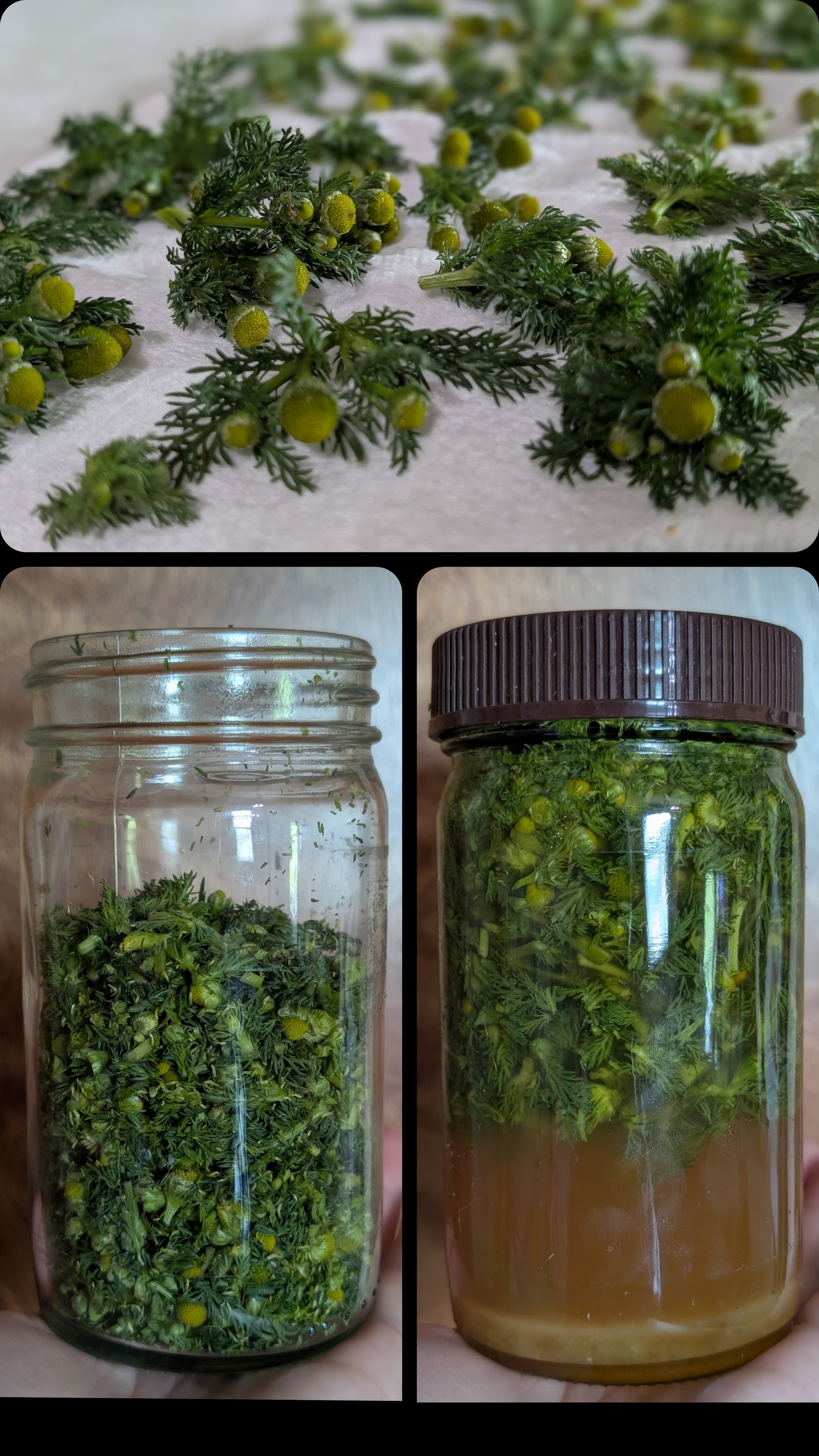
Fresh pineapple weed – flower heads and tender tops: Enough to fill a glass jar about 3/4 full (if using dried, fill jar 1/4 full)
Raw Apple Cider Vinegar (ACV): Use a high-quality brand with the mother.
Local Raw Honey
Instructions
Clean your pineapple weed and give it a rough chop to break the cell walls and release the volatile oils. Place the herbs in a glass jar. Don’t pack them too tightly; you want the liquid to circulate. Pour vinegar over the herbs until the jar is 3/4 full, and then top the rest of the jar with honey. You want the herbs completely submerged and about an inch of head space at the top.
Stir well with a wooden spoon to remove air bubbles. Cap the jar with a plastic lid (vinegar will corrode metal) and store it in a cool, dark place for 2 to 4 weeks. Shake the jar daily.
Once the infusing time has passed, strain out the plant material through a fine-mesh strainer or cheesecloth, squeezing firmly to get every medicinal drop. Store your finished oxymel in a clean glass jar in the refrigerator. It will stay potent for 6 months to a year.
Dosage
Stir a tablespoon into a glass of sparkling water or warm tea, or use it in salad dressings and marinades, or just take it by the spoonful. The flavor is usually a hit, even for children – it tastes like a tangy pineapple candy.
For pre-meal support, take a teaspoon 15 minutes before eating to help stimulate digestion and stabilize mast cells in the gut.
For Folks like Me with AGS/MCAS
For conditions involving hypersensitivity like Alpha-gal Syndrome (AGS) and Mast Cell Activation Syndrome (MCAS), pineapple weed can be a supportive ally due to its specific chemical profile.
Caution: Because those with MCAS can react to almost anything, always start with a scent test (smelling the crushed herb) and then a tiny sip test before incorporating it into your daily routine.
For MCAS (Mast Cell Stabilization)
- Quercetin & Apigenin: Pineapple weed is rich in these two flavonoids, which are well-documented natural mast cell stabilizers. They work by inhibiting the release of histamine and pro-inflammatory cytokines (like TNF-α and IL-6) from your mast cells.
- The Benefit: Taking a daily pineapple weed infusion or oxymel may help “lower the bucket” of your overall histamine load, potentially reducing the frequency of flares.
For AGS (Alpha-gal Syndrome)
- GI Support: AGS often manifests as delayed gastrointestinal distress (cramping, diarrhea, nausea) after consuming mammal products. Pineapple weed’s spasmolytic effect helps calm the smooth muscles of the gut during these reactions.
- Anti-Inflammatory Buffer: Because it lacks the chamazulene found in German and Roman chamomile, it is often less likely to trigger a reaction in highly sensitive individuals while still providing an anti-inflammatory buffer for the body’s immune system.
*Note: Your body can only absorb so many flavonoids at once. It is much more effective to drink three small cups spread throughout the day than to chug one quart all at once. This keeps a steady level of mast-cell stabilizers in your bloodstream.
Suggestions for using pineapple weed to help with MCAS/AGS: - Tummy Prep (15 mins before meals): Take 1 teaspoon of oxymel in a splash of water. This stabilizes the mast cells in your gut before they encounter potential triggers in your food (especially helpful for the delayed GI issues with AGS).
- Mid-Day Buffer: If you’re heading out to work in the heat (which can be a mast-cell trigger!), take 1 teaspoon to give your immune system a cooling layer of anti-inflammatories.
- Evening Calm: A final 1 teaspoon before bed helps settle the nervous system and prevents the histamine dump that many MCAS/AGS people experience in the middle of the night.
Want a More Comprehensive Supplement for AGS/MCAS?
Provided a person tolerates the pineapple weed oxymel, there are several other plants that could potentially be paired with pineapple weed to help with AGS/MCAS:
1. Stinging Nettle (Urtica dioica)
Nettle is the heavy hitter for histamine. It contains natural antihistamines and is a potent H1 receptor antagonist.
- Why it pairs well: While pineapple weed stabilizes the mast cell (stopping the release), nettle helps block the histamine that has already escaped.
- AGS Tip: Since AGS often comes with mineral depletion, nettle is a great multivitamin in a jar.
- Foraging Note: I haven’t found any yet but sources say to look for it in the moist, rich soil near your creek beds and always wear gloves! For now, I just purchase a stinging nettle supplement – but I am keeping my eyes open!
*Note: If you find nettles this summer, keep an eye out for the green seeds in late August. They are a legendary ‘homestead espresso’—just a pinch can help clear heavy brain fog!
2. Wild Bergamot / Bee Balm (Monarda fistulosa)
This beautiful lavender-flowered plant is rich in thymol and carvacrol.
- Why it pairs well: It is a powerful digestive antispasmodic. If you experience the delayed GI cramping common with AGS, adding monarda to your pineapple weed tea can help relax the smooth muscles of the gut.
- Flavor Profile: It has a spicy, oregano-like kick that balances the sweetness of the pineapple weed. Fortunately, I already have this growing in my garden!
3. Plantain (Plantago major or P. lanceolata)
Often called “the band-aid of the earth,” plantain is a potent anti-inflammatory for the gut lining and the skin.
- Why it pairs well: If your MCAS presents as skin hives or leaky gut issues, plantain provides a soothing, mucilaginous layer that protects your membranes.
- Foraging Note: It likely grows right next to your pineapple weed in the compacted soil of your driveway or backyard!
4. Perilla / Shiso (Perilla frutescens)
You might find this “Beefsteak” plant escaped from gardens or growing in shadier pasture edges. It is one of the most researched herbs for MCAS because it is incredibly high in rosmarinic acid and luteolin.
- Why it pairs well: Clinical studies show Perilla can significantly inhibit the release of TNF-alpha and other inflammatory cytokines.
- Flavor Profile: It has a unique cinnamon-clove-mint flavor that makes an oxymel taste like a sophisticated tonic.
Potential Mast-Cell Support Blend
2 parts Pineappleweed (Stabilizer)
1 part Nettle (Antihistamine)
1 part Plantain (Membrane Support)
1 Part Perilla (The Cytokine Inhibitor)
A pinch of Monarda (Antispasmodic)
If you want the best extractions of everything, make an infusion of the nettles and plantain and then add a tablespoon of pineapple weed, perilla, and monarda oxymel. This is because the vinegar in an oxymel is a superior solvent for the alkaloids, flavonoids, and volatile oils in monarda, perilla, and pineapple weed while water is the best solvent for the high mineral content of nettles and the soothing mucilage of plantain.
However, if you don’t want to have to make a new infusion every day or two, you could just make an oxymel with all of the herbs. The biggest hitters for MCAS (quercetin and luteolin) are going to be more bio-available with an oxymel anyway and that way you aren’t having to make your herbal supplements daily.
Note: Because MCAS makes the body hyper-reactive, I recommend introducing one new herb at a time. Start with the pineapple weed for a few days. If that goes well, add the nettle for a few days, and so on. This ensures if you don’t tolerate something, you will know which herb it is.
Disclaimer: I am not a doctor. Always consult with a medical professional before introducing new wild herbs into your diet, especially if you are pregnant, nursing, or have existing health conditions.
Activities for the Kiddos
Since pineapple weed grows low to the ground and is incredibly fragrant, it’s a favorite for little foragers. Aside from letting them help forage it (my kids love finding and harvesting pineapple weed!) and/or make any of the above recipes with you, here are some other fun activities for them:
- Crush and Sniff: This is a classic forager’s game to help them develop their nature nose. Blindfold one child (or just have them close their eyes tightly). Hold a crushed dandelion in one hand and crushed pineapple weed in the other. Have them identify the pineapple weed by smell alone. I wanted to give my twins even more of a challenge so I actually picked a dandelion, purple dead nettle, and pineapple weed and asked them to identify what they each were by scent alone. It was a fun little activity for everyone!
Variation: Have your kids close their eyes and see if they can find the pineapple weed patch using only their senses of touch and smell. It’s a great way to sharpen their sensory awareness. - Wild Sprinkles: Let kids harvest the flower heads and use them as nature’s sprinkles on top of their yogurt or oatmeal.
- “Chemistry”: Give the kids a mortar and pestle (or just two flat stones) and have them grind the flowers with a little water to make a perfume or potion.
- Solar Tea Science: Kids love watching things change so a sun-brewed tea is a perfect activity and a great exercise in patience. Let them fill a clear glass quart jar with water and as many pineappleweed heads as they can pick. Set it somewhere in the sun. Every hour or so, have them check the color. Given time to steep in the sun, the water will be a beautiful pale gold. Let them enjoy a glass of their sun brewed pineapple weed tea as a reward.
Faith Connections
1. Inner Beauty Over Outer Appearance
- The Lesson: Unlike its showy cousins like the daisy or chamomile, pineapple weed has no petals. It is often overlooked because it doesn’t fit the standard definition of a flower. Yet, its fragrance is the sweetest of them all.
- The Verse: “For the Lord sees not as man sees: man looks on the outward appearance, but the Lord looks on the heart.” — 1 Samuel 16:7
- The Takeaway: We don’t need “petals” or worldly accolades to be fragrant for the Kingdom. Our value is in the sweetness of our spirit, not our outward show.
2. Thriving Under Pressure
- The Lesson: Pineapple weed doesn’t just grow in the driveway; it prefers it. It thrives in the compacted, hard soil of high-traffic paths where other plants are crushed.
- The Verse: “We are hard pressed on every side, but not crushed; perplexed, but not in despair.” — 2 Corinthians 4:8
- The Takeaway: Sometimes God places us in difficult seasons where it feels like we are being trampled and crushed because that is exactly where we are designed to bloom. The pressure doesn’t destroy us; it refines us and defines our strength.
3. The Fragrance of the Crushed
- The Lesson: You can walk past a patch of pineappleweed and never notice it. It is only when it is stepped on or crushed between your fingers that it releases its incredible, tropical scent.
- The Verse: “Now thanks be to God who always leads us in triumph in Christ, and through us diffuses the fragrance of His knowledge in every place.” — 2 Corinthians 2:14
- The Takeaway: Often, our greatest testimony for Christ is released during our times of “crushing.” Our trials allow the fragrance of His grace to be known to those around us.
4. Provision in the Waste Places
- The Lesson: We often look for God’s blessings in the lush garden, but pineappleweed is a reminder that He provides “honey in the rock”.
- The Verse: “I will even make a way in the wilderness, and rivers in the desert.” — Isaiah 43:19
- The Takeaway: God’s provision isn’t limited to the “good soil” of our lives. He can turn a dusty, forgotten path into a place of refreshment and healing.
Next time you’re walking down the driveway to check the mail or heading out to the barn, take a second to look down. You might just find a little piece of the tropics waiting right under your boots. These trampled tropics are a reminder that the most profound healing often hides in the most humble places.
I’d love to hear from you: Have you noticed this little petal-less wonder on your own paths? Or perhaps you have a favorite driveway “weed” that you’ve discovered has a hidden beauty of its own? Tell me about it in the comments!


 Radiant Roots
Leave a reply to Dandelions: Not a Weed – A Forager’s and Homesteader’s Treasure! – Radiant Roots Cancel reply